
Before the first note
Before a flamenco guitar is heard, it is played.
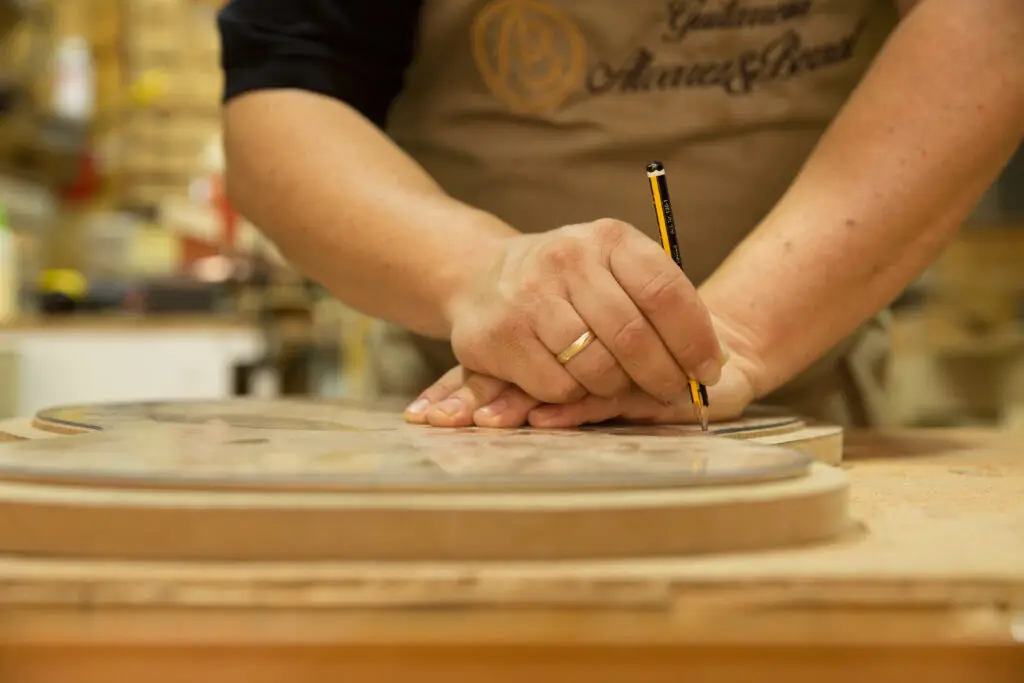
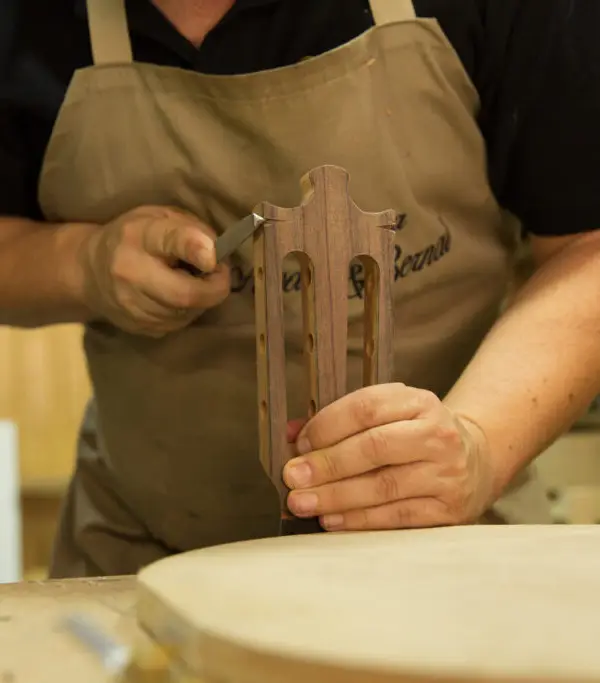
Before responding to the musician’s hands, it has already passed through the hands of a craftsman. Long before its strings sound a single note, there is wood that must be selected, studied, shaped, assembled, polished, and patiently brought to life.
We often encounter the flamenco guitar at the moment it is already playing its part: accompanying the voice, responding to the rhythm of the *zapateado* (footwork), and filling the space between the dancer and the singer. In flamenco, the guitar becomes part of a conversation between cultures, sounds, and forms of expression. It can accompany, respond, interrupt, and guide. Yet behind this dialogue, which seems to flow effortlessly, lies another story, one that begins much earlier, in the luthier’s workshop.
Listening to the forest
To understand the guitar is, in many ways, to understand the material from which it is made.
Different woods possess distinct qualities. Their grain, density, resonance, and character shape the finished instrument. For the luthier, therefore, wood is not merely a material to be worked; it is something to be observed and understood. The process involves listening before there is anything to hear.
Where music and nature meet
Few people understand the relationship between nature, material, and music as intimately as the Sevillian luthier Antonio Álvarez Bernal.
His journey into guitar making began not with wood, but with music. During his childhood in Camas, he studied music and played the clarinet, percussion, and various wind instruments. Music became a way of understanding sound, while his growing knowledge of botany and different tree species gave him another language for understanding the materials capable of producing it.
Over time, the two worlds began to converge.
Álvarez Bernal describes his relationship with wood in almost musical terms: the possibility of, in his own words, endowing a piece of wood with music, almost infusing it within. It is a mindset that places the luthier somewhere between artisan, musician, and observer. Rather than imposing a predetermined character on the material, the work becomes a process of discovering what is already there.
Each stage requires knowledge and a patience cultivated through practice.
From the workshop to the world
Álvarez Bernal’s instruments have found their way into the hands of artists such as Manuel Carrasco and Alejandro Sanz. One of his guitars was even presented by the city of Seville as a gift to former U.S. President Barack Obama. Yet, despite having traveled far beyond the walls of his workshop, each instrument retains the imprint of the place where it was born.

Returning to the beginning
This September, the Museum of Flamenco Dance invites visitors to return to those origins.
Going beyond merely presenting the guitar as a finished instrument, the exhibition opens a window into the world hidden behind it. Inspired by the atmosphere of a traditional luthier’s workshop, it brings together photographs, materials, objects, drawings, and details of the construction process to reveal what usually remains unseen.
Here, visitors are invited to pause.
To observe the grain of the wood. To focus on a tool, a joint, a surface, or a small mark left by the artisan’s hand. To reflect on the time embodied in an object that, when finally played, may seem the result of an almost imperceptible effort.
The flamenco guitar is a story of transformation.
And sometimes, to truly hear the music, we must first learn to look.